
Short answer: AI doesn't replace marketers — but it does expose the ones who were only executing … without thinking.
This is the output from a NZ Trade and Enterprise webinar that I co-hosted in May on Marketing and AI. It covers off the many things I didn't have time for in the session.
If your marketing has been all execution and no strategy, AI will execute faster and cheaper than you can. If your marketing is built on customer insight, a clear plan, strategic judgement, and a commitment to optimisation, AI becomes a high-performance tool that can help your marketing team go further, faster with less resources.
That distinction is the whole game. So let's unpack it, then get into how you'd actually start.
Does AI replace your marketing team?
No — but it changes where to direct your team's money and time.
One way to think about it is that AI is like buying a high-performance car. You can go a lot faster, but you still need a driver who's trained to handle it. Point it in the wrong direction at speed and you'll be off the track and in a 'hot situation' quicker than you can say Romain Grosjean's Bahrain Grand Prix. Someone still has to direct the work using the strategy, evaluate strategic course corrections, and quality control the outputs.
There's an uncomfortable fact here too. Boathouse's fifth annual CEO study found that 57% of CEOs primarily see their CMO as an execution leader rather than a strategic advisor, and CEOs hold CMOs four times more accountable for AI ROI than any other executive. Marketers are being measured on AI returns while simultaneously being viewed as the people who make the stuff, not the people who decide what matters.
If marketing is perceived as purely executional, then of course it looks replaceable by a tool that executes. It's a fallacy — but it's a fallacy marketers have partly created by being brilliant operators who never made the strategic thinking visible. Or not applying enough time to strategic thinking.
I have seen, repeatedly, marketing teams failing to communicate strategically to leadership, particularly budget stakeholders — this means things like ROI, effectiveness and recommended strategic course corrections.
Another important side-note for budget holders — compared to their overseas counterparts, NZ marketing teams are often under-resourced. AI used correctly should help businesses to get more value out of very limited budgets. I think lack of resources (ie: time) is one of several reasons marketing teams struggle with elevating strategic thinking to the top table vs just presenting as executional.
In an AI world, strategy becomes even more important. The work AI cannot do for you is still the work that matters most:
- Knowing your customer. AI guesses but you need to know. You can use it for desk research to break the ground, but nothing beats real world input — from your qualitative and quantitative research, customer data, customer success/support and sales team input.
- Strategic thinking and a plan. Using AI without marketing foundations doesn't fix bad marketing. It produces bad marketing faster. You need to synthesise your plan into: buyer personas/priority target customer segments, brand messaging and tonality, product USPs, etc etc.
- Quality control. A lot of AI output is waffly, generic and obviously machine-made. Customers can smell it. Worse, AI recommendations are often subtly flawed — and you only catch that if you already know what "great" looks like. With a clear understanding of quality, you'll also be able to discern where you need to deploy (for example) human crafted content vs AI generated. Also many media channels are now labelling work as AI rendered. All this does is render your message as spam, and pretty soon AI will be used to label AI content as AI and possibly have a little label on it — as YouTube does now flagging inauthentic content.
We've watched clients rebuild their websites over a weekend using AI, convinced they'd nailed it, with no grasp of UX, brand tonality or who the site was actually for. Self-belief isn't quality control. Nobody wants to be told their baby is ugly — but if deployed, those sites do real damage.
So the shift isn't "fewer marketers". It's fewer foot soldiers, more captains. Also more disciplined "best practice" marketing. AI raises the bar rather than removing the people. If you used to produce three social posts a week, the expectation now is more posts across more channels — because that's exactly what your competitors are doing. The marketers who win are the ones who can own and demonstrate the strategic layer: what we tell the AI to do, and why(?), becomes the most important question in the building.
In the great words of Bill Bernbach, founder of DDB, "Nobody counts the number of ads you run; they just remember the impression you make."
How to identify the right things to do
Before you adopt a single tool, you need two things many resource-poor marketing teams skip.
First, a baseline. You can't tell whether AI is helping if you never measured your marketing performance to begin with. "We cut costs with AI" is meaningless on its own — if effectiveness drops even more at the same time, you've made things worse. Measure now, measure as you go, and attribute back to AI where you honestly can.
Second, the right data. AI is only as good as what you feed it. Two questions decide whether you're ready:
- Is it connected? Can the AI meaningfully join up siloed data across the stages of your customer journey?
- Is it clean? Is it measuring what it should? We recently found a client's GA4 Key Events set up incorrectly — they'd been reporting the wrong conversions for months. AI built on that would have confidently optimised toward the wrong outcome.
With a baseline and clean data in place, the way to find the right opportunities is to grade them by feasibility and returns/impact using a fairly traditional prioritisation matrix.
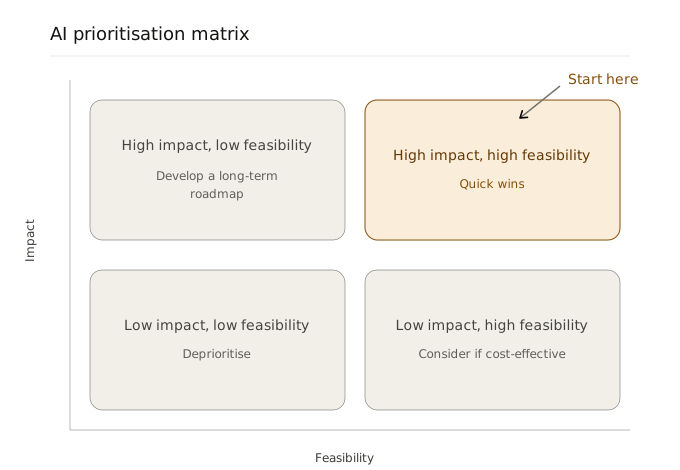
Not every task carries the same cost if the AI gets it wrong, so we use three zones:
- Automate freely. Tasks where errors are invisible or caught instantly — for example, generating Schema.org markup. Let it run.
- AI drafts, human reviews. Content that goes out externally but is quick to correct — social posts, FAQ content. AI does the first pass, a human approves.
- AI assists, human leads. High-stakes, client-facing work where a mistake damages trust — strategy documents, case studies, anything making specific claims about results, and all your core creative and strategic thinking. Here AI is the assistant, never the author.
Map your marketing tasks across those three zones and your starting points fall out naturally. Begin where AI errors are cheap and the time saved is real. Stage the rest.
Three things to get started on
If you want practical first moves rather than a complete transformation programme, start here.
1. Content — but don't try to generate all of it
The obvious place to start is content, and the obvious question is: can I just generate all of it with AI now? The short answer is no.
Brands are built on trust. If all of your content is visibly "generated by the machine," you present as synthetic rather than human-centred — and customers can tell. So the skill is knowing where trust-building is required and where content is merely transactional. A how-to guide for a feature of your SaaS platform is fairly transactional. A page explaining your sustainability practices, where you're asking the audience to trust you, is not. Treat them differently. Also remember with generating content for SEO and GEO, sometimes we're writing for the machine, ie: web crawlers, rather than the human. This is also transactional content.
It also helps to be honest about what AI can and can't do well. Not all marketing content can be effectively generated by AI — and producing what gets called "AI slop" does your brand no favours at all. That's exactly why marketers need to understand what great really looks like. Where AI is really useful in content generation is breaking the ground: the fear of the blank canvas has plagued content creators for centuries, and AI is brilliant at the first pass, letting an experienced person come in to develop and polish from there. Or perhaps even using the AI content as the brief for something hand crafted.
A few practical moves:
- Brief it properly. Your marketing foundations — look and feel, tonality, messaging, target customer — need to be created, validated and then loaded into the LLM so output is actually directed. The more you experiment and refine, the better it gets.
- Use the tooling that streamlines it. Tools like Claude Design to manage the brand guidelines, paired with Canva for design and managing the social media calendar will let you genuinely streamline content production for social media without losing control.
- Capture and iterate what works. Build a prompt library — GitHub or just a spreadsheet — and refine it as you test. You don't want to re-invent the wheel every time.
2. SEO and GEO: think answers, not rankings
Search is changing, but not in the way most people think. It isn't a clean switch from SEO to AI search — SEO and GEO (Generative Engine Optimisation, optimising to be cited by AI systems like ChatGPT, Perplexity and Google's AI answers) overlap heavily. What changes is the thinking.
Traditional SEO meant ranking for keywords and winning the click. In AI search, your prospect's first impression of you is often formed inside the answer, before they ever see your website. The question stops being "what do we rank for" and becomes "what share of the answer do we hold".
This is good news for mid-sized businesses. When someone asks an AI a question, it breaks it into five or ten smaller searches and builds the answer from multiple sources. And people ask AI long, conversational, specific questions nobody ever typed into Google. The long tail just got much longer. You don't need to win the big head terms anymore — you need to be the best source for one facet of a hundred specific questions. That favours genuine specialists over big-budget generalists.
Start with a ten-minute exercise: ask ChatGPT and Perplexity what they know about your company and your category. Or use a tool like Gumshoe.ai. Whatever is missing or wrong is your content plan. In practice the work looks like:
- Coverage: deep, specific answers to the real questions in your category, not one page per keyword.
- Answer-first writing: the punchline in the first paragraph, with facts, figures and plain claims an AI can lift and cite.
- Authority: third-party mentions on credible platforms — LinkedIn, Reddit, industry press — because AI judges credibility from the whole web, not just your site. Increasingly a PR job, and the links benefit your SEO too.
- The basics: a fast, crawlable site with structured data in place. Necessary, but no longer the point.
For more detail see the earlier piece Kieren and I wrote on SEO and GEO.
3. Automate your reporting and optimisation
This is the single most common gap we see with New Zealand exporters — marketing happening with almost no effective reporting behind it. You cannot deliver value that way, and AI can fix it fast.
Connect your reporting platforms — GA4, Google Ads, your social channels — to Claude or ChatGPT through a piece of middleware like Windsor.ai, and you can automate the monthly reporting grind entirely. From there you can set up AI to monitor for spikes, troughs or underperforming campaigns and alert you, ask far better ad hoc questions of your own data, and get AI suggestions on what to optimise. The bonus: stop outsourcing reporting to your agency and you hold them to account properly.
The bottom line
AI doesn't replace marketers. It raises the bar, collapses the time from idea to execution, and makes strategy more valuable than it has ever been — because the quality of what you tell the AI to do now decides the quality of everything that comes out.
The businesses that win won't be the ones who replaced their marketers. They'll be the ones whose marketers stopped merely operating executionally and started owning and applying strategic thinking. Start with clean data and a baseline, grade your opportunities to build a solid roadmap, and get moving on the three things above.
JungleGym is a growth consultancy. We help mid-market CEOs and founders across New Zealand, Australia and the UK use AI to accelerate growth — without losing the strategic judgement that makes marketing work. If you want a hand getting started, get in touch.